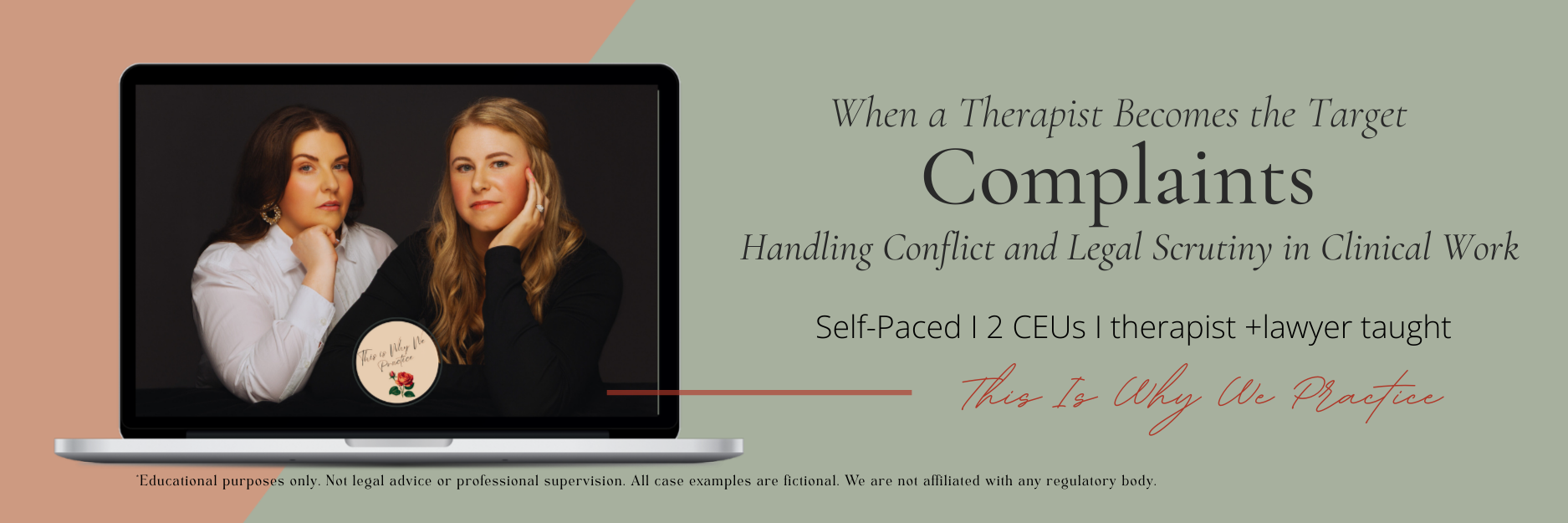
Why this course exists
Most therapists hope to never receive a complaint. But complaints do happen. Often in complex situations involving boundaries, documentation, misunderstandings, or difficult endings. When they do, the process can feel confusing, isolating, and overwhelming. This course walks through what happens during a complaint process and how clinicians can respond thoughtfully and ethically.
Inside the course, you'll learn:
• understand how complaint investigations typically unfold • respond to regulators and documentation requests • write a thoughtful and professional response letter • navigate the emotional impact of a complaint • avoid common mistakes that make situations worse • use consultation and supervision effectively during the process
Course Curriculum
-
1
-
(Included in full purchase)
Welcome + Course Orientation (Becky + Betti)
-
Learning Outcomes Free preview
-
(Included in full purchase)
-
2
-
(Included in full purchase)
High-Conflict Systems & Therapist Vulnerability
-
(Included in full purchase)
When the Therapist Becomes the Target
-
(Included in full purchase)
-
3
-
(Included in full purchase)
How Complaints Happen
-
(Included in full purchase)
The Complaint Process Clarification
-
(Included in full purchase)
Scenario Integration: When You’ve Done Everything Right… and It Still Escalates
-
(Included in full purchase)
-
4
-
(Included in full purchase)
Language That De-Escalates Without Collapsing
-
(Included in full purchase)
Documentation as Protection
-
(Included in full purchase)
When to Call Insurance
-
(Included in full purchase)
Techniques for De-escalating Conflict
-
(Included in full purchase)
-
5
-
(Included in full purchase)
Am I in Trouble? What Happens If a Therapist Ends Up in Court
-
(Included in full purchase)
How Do I Reply? Responding to Complaint Threats
-
(Included in full purchase)
What Can Happen to My Notes?
-
(Included in full purchase)
How a Lawyer Helps
-
(Included in full purchase)
A Lawyer Contacted Me, Now What?
-
(Included in full purchase)
-
6
-
(Included in full purchase)
A Non-Defensive Ethics Review When a Complaint Lands
-
(Included in full purchase)
Staying Grounded and Ethical When Under Scrutiny
-
(Included in full purchase)
The First 72 Hours
-
(Included in full purchase)
The First 72 Hours: A Practical Checklist for Clinicians
-
(Included in full purchase)
-
7
-
(Included in full purchase)
Closing Reflections
-
(Included in full purchase)
Resource Guide: Complaints, Ethics and Legal Risk in Clinical Practice
-
(Included in full purchase)
Quiz for CE
-
(Included in full purchase)
Course Reflection & Learning Feedback
-
(Included in full purchase)
CE Credits: Instructions for certificate, self-reflection question, and CE logging
-
(Included in full purchase)
This course is for you if:
• you’ve worried about what would happen if a complaint occurred • you supervise other clinicians and want to understand the process • you want to strengthen your documentation and ethical decision-making • you want clarity instead of speculation about regulatory processes • you are a Canadian private practice therapist
This course is NOT about:
• avoiding accountability • legal loopholes • defensive practice Instead, it focuses on thoughtful clinical reflection and navigating complaints with professionalism and integrity.

Why this course is different
Most ethics courses come from one perspective. This course is taught by a therapist and a family lawyer, bringing together: -Clinical ethics -Legal process -Professional accountability Our aim is to help clinicians think clearly when difficult situations arise. With: Becky Palmer, Registered Clinical Counsellor (RCC) Betti White, BC Family Lawyer
Common Questions Therapists Ask:
What if I've never received a complaint? Understanding the process strengthens ethical decision-making and documentation practices in everyday work. Often it's not a matter of if, it's a matter of when you'll receive the threat of a complaint. Understanding the process ahead of time can reduce uncertainty and strengthen documentation and ethical decision-making in daily practice. Is this only for serious misconduct cases? No. Many complaints arise from misunderstandings, boundary confusion, or difficult endings. Will this make me more anxious? Most clinicians report the opposite: understanding the process reduces fear and increases confidence. If you want a clearer understanding of the complaint process, and how thoughtful clinicians can navigate it, this course was created for us.
$125.00
Disclaimer
This course is provided for educational and reflective purposes only. The content is intended to support professional learning, ethical awareness, and general understanding of clinical, regulatory, and legal processes. It does not constitute legal advice, clinical supervision, therapeutic treatment, or regulatory guidance. Case examples presented in this course are fictional and are used solely for illustrative and educational purposes. Any resemblance to real individuals or situations is coincidental. Participation in this course does not create a lawyer–client, supervisor–supervisee, or therapeutic relationship between participants and the facilitators. Clinicians are responsible for applying the material in a manner consistent with their own professional judgment, scope of practice, regulatory requirements, and applicable laws within their jurisdiction. While the course includes BC-specific references, the content is not a substitute for consulting a qualified lawyer, professional liability insurer, clinical supervisor, or regulatory body regarding individual circumstances. We are not affiliated with any regulatory body.